

Inferior Turbinate Hypertrophy (Swollen/Enlarged Turbinates)
Understanding Causes, Symptoms and Treatment Options
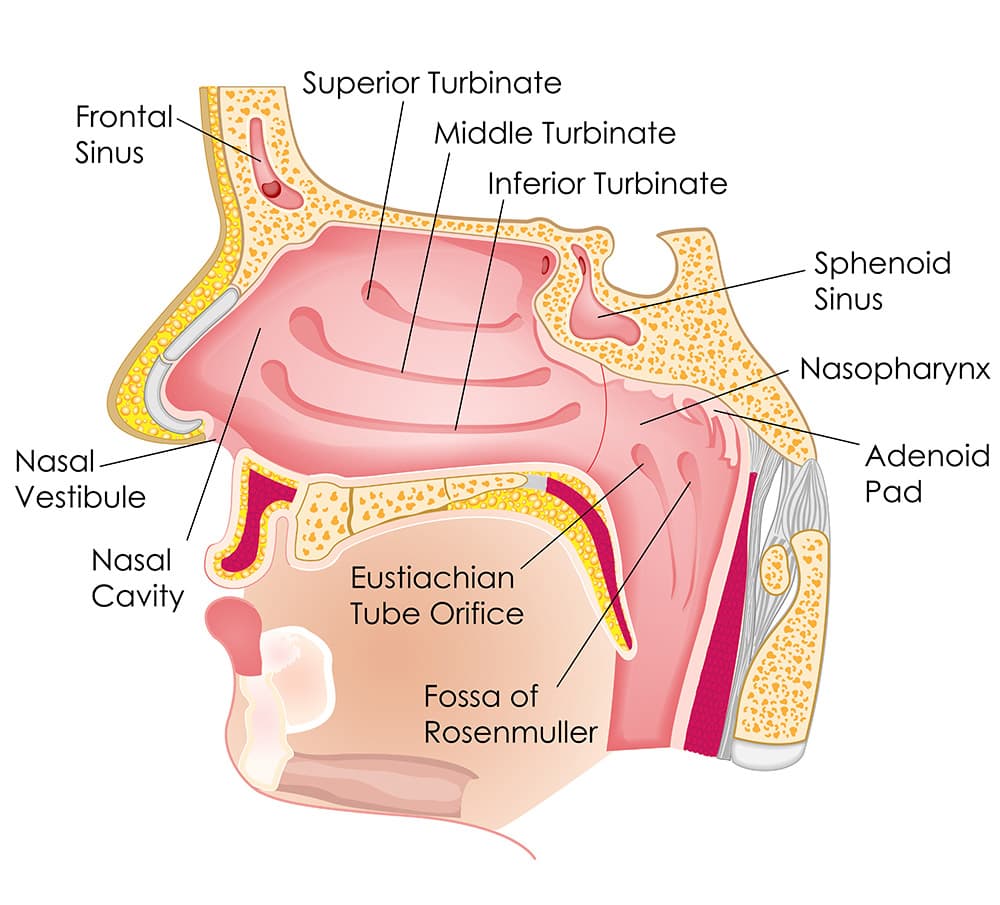
The nasal turbinates are structures inside the nose that help warm, filter and humidify the air you breathe.
When they become persistently enlarged, a condition known as turbinate hypertrophy can develop, often causing a constant blocked or “stuffy” nose even without a cold or infection.
Most cases involve the inferior turbinates, which have the greatest impact on everyday nasal breathing. The enlargement is usually due to ongoing inflammation of the turbinate lining, rather than true tissue growth:
This explains why nasal blockage may fluctuate during the day while remaining a long-term issue. Turbinate hypertrophy may also occur as a response to other nasal conditions, such as a deviated septum.
In Singapore’s warm, humid climate, symptoms are commonly reported to worsen in air-conditioned environments, during haze episodes, or after repeated upper respiratory infections.
Symptoms of turbinate hypertrophy
Symptoms of inferior turbinate hypertrophy are often persistent rather than episodic and may fluctuate throughout the day. Many patients describe a blocked or congested nose even when there is little or no mucus present.
Because turbinate swelling can change with posture, environment and inflammation, symptoms may feel worse at certain times, such as at night or in air-conditioned settings.
You may experience:
| Ongoing nasal blockage or congestion, often affecting both sides | Reduced airflow through the nose, despite minimal nasal discharge | Alternating nasal blockage, where one side feels blocked at a time |
| Mouth breathing, particularly during sleep | Snoring or disturbed sleep related to nasal obstruction | Poor response to nasal sprays or allergy medication |
As these symptoms can overlap with allergic rhinitis or sinus conditions, further assessment is often needed to identify the underlying cause of nasal obstruction.

Dr. Ong Yew Kwang
Senior Consultant ENT Specialist & Rhinologist
Dr Ong Yew Kwang is an experienced ENT specialist with over 20 years of clinical practice. He graduated with honours from Trinity College, University of Dublin and completed ENT specialist training in 2008, earning the gold medal in the national exit examination. He later undertook subspecialty fellowship training in Rhinology and Endoscopic Skull Base Surgery at the University of Pittsburgh Medical Center, USA.
Before entering private practice, Dr Ong served as Senior Consultant and Director of Clinical Service at the National University Hospital (NUH), where he co-led the endoscopic skull base programme. He also holds a Master of Medicine in Sleep Medicine and a Post-Graduate Certificate in Allergy.
What causes inferior turbinate hypertrophy?
Inferior turbinate hypertrophy most often results from chronic inflammation of the nasal lining. Rather than bone enlargement, the swelling is usually caused by inflammation of the soft tissue lining the turbinate.
A common contributing factor is allergic rhinitis, where ongoing exposure to airborne allergens leads to sustained nasal inflammation. Even when allergy symptoms appear mild, turbinate swelling may persist and cause long-term nasal blockage.
Turbinate hypertrophy can also develop as a compensatory response to other nasal conditions. In individuals with a deviated nasal septum, the turbinate on the wider side of the nose may gradually enlarge to regulate airflow, eventually contributing to obstruction.
Other factors may include:
- Prolonged use of decongestant nasal sprays
- Exposure to environmental irritants such as smoke or pollution
- Hormonal changes
- Repeated upper respiratory infections.
In some cases, more than one factor may contribute.
Identifying the underlying cause helps guide management and determine whether symptoms are likely to respond to medical treatment.
How is turbinate hypertrophy diagnosed?

Diagnosis begins with a clinical consultation and nasal examination.
Your ENT specialist will review your symptoms, how long they have been present and whether they fluctuate with factors such as allergies, environment or medication use.
Persistent nasal blockage that responds poorly to sprays is often an important clue.
A focused nasal examination may show enlarged inferior turbinates, often with signs of chronic inflammation.
To assess this more accurately, a nasal endoscopy may be performed. This in-clinic procedure allows direct visualisation of the nasal passages and helps confirm turbinate swelling while excluding other causes of obstruction, such as nasal polyps or significant septal deviation.
Imaging tests are not routinely required but may be considered if sinus disease or other structural conditions are suspected.
Can swollen turbinates improve on their own?
In some cases, turbinate swelling may improve if the underlying trigger is addressed, such as better control of allergies or avoidance of irritants. However, when inflammation has been present for a prolonged period, symptoms may persist despite simple measures.
Fluctuating nasal blockage that never fully resolves often suggests chronic turbinate hypertrophy, which may require targeted management rather than watchful waiting alone.
Turbinate hypertrophy treatment
Treatment for turbinate hypertrophy is guided by symptoms, underlying causes and response to initial therapy. Management is usually approached in a stepwise manner, starting with conservative measures before considering procedures when necessary.
Non-surgical management
Treatment often begins with conservative, non-surgical measures to reduce inflammation and improve nasal airflow. This approach is most effective when turbinate swelling is driven by ongoing inflammation rather than fixed structural change.
Management typically includes saline nasal rinses to clear irritants and support nasal hygiene, along with regular use of intranasal steroid sprays to reduce turbinate swelling. Where allergies contribute, antihistamines or allergy-directed treatment may be recommended.
In patients with persistent swelling of both inferior turbinates, controlling underlying rhinitis is particularly important. For those exposed to environmental irritants such as haze or pollution, longer-term strategies may include minimising exposure and maintaining consistent treatment.
Minimally invasive procedures or surgery
When symptoms of inferior turbinate hypertrophy persist despite appropriate medical treatment, advanced ent procedures or surgical options may be considered in selected cases. These approaches aim to reduce turbinate size while preserving their normal function in nasal airflow.
Minimally invasive procedures are commonly used to address ongoing turbinate swelling and are performed through the nostrils without external incisions. Surgery may be discussed in more severe or long-standing cases, particularly when other nasal structural issues are present.
The choice of approach depends on individual anatomy, symptom severity and overall nasal structure, and is best determined during a consultation with your specialist.
Learn more about turbinate reduction procedures.
A structured approach to managing turbinate hypertrophy

Nasal blockage can affect individuals differently and symptoms related to turbinate hypertrophy may persist even when other nasal conditions are well controlled.
Effective management often requires more than a one-size-fits-all approach, particularly when turbinate swelling contributes to ongoing obstruction.
By understanding symptom patterns, contributing factors and response to treatment, care can be tailored to help improve nasal airflow and overall comfort over time.
If symptoms related to turbinate hypertrophy are persistent or affecting daily activities or sleep, a review with an ENT specialist can help clarify the diagnosis and guide appropriate next steps.
Appointments are available for assessment and second opinions.